
Selling WA tenements: who would buy them, and what they'd pay for
A list of the neighbours is not a list of buyers. What we learned building buyer lists for WA exploration ground: tracing holders to their parents, telling appetite from tidying up, finding the mill that wants the ore, and spending the commitment on the drilling a buyer will pay for.

A few weeks ago a user asked us a simple question about a couple of its WA projects: who would buy them?
It sounds like an afternoon with a map. Pull up the tenure, list the neighbours, sort them by how much ground they hold. Almost nothing on that list turned out to be what it looked like. Working out why became a service, the divestment review, and this post is what we learned building it. Most of it is useful whether or not you ever ask us for one.
A neighbour list is not a buyer list
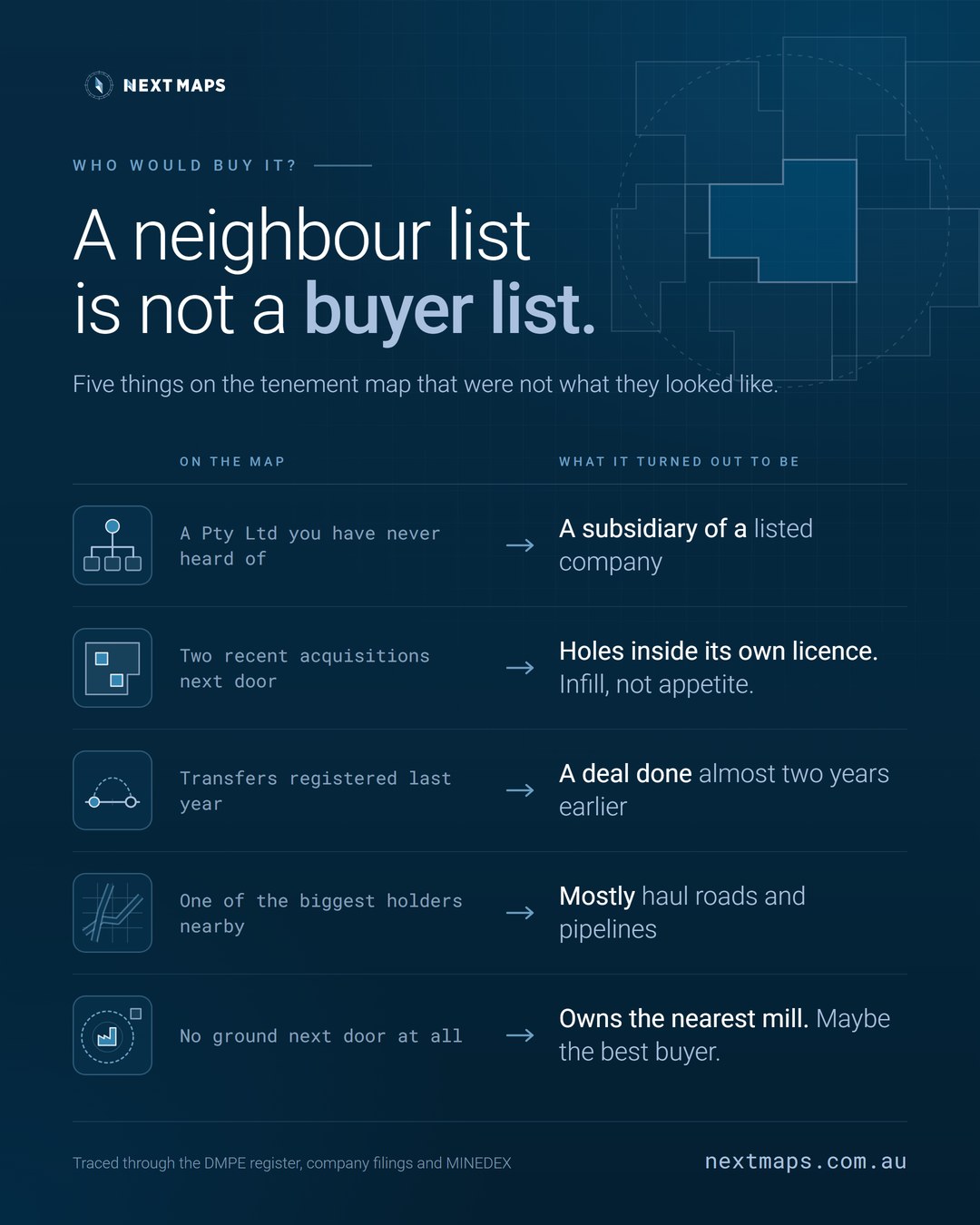
The register names holders, not owners
The DMPE register records who holds each title, and that is often a Pty Ltd you have never heard of, a numbered company or an entity named after a project. Before a list of neighbours means anything, every holder has to be traced to the company that owns it. Listed companies name their subsidiaries in the Consolidated Entity Disclosure Statement in each annual report, so most of the tracing can be done from filings.
Two traps catch people out. Listed companies that hold ground in their own name are easy to miss when you are hunting for subsidiaries. And some of the biggest groups in WA file no Australian statement at all, because they are listed overseas or privately owned.
A recent acquisition is not always appetite
A neighbour that has been buying titles nearby looks like a company hungry for ground. Put the titles on the map before believing it. On one of our reviews, a neighbour's recent purchases were holes inside its own licence outline: it was tidying up its boundary, not looking for more. And a company that is selling ground nearby is not a buyer at all. It is a candidate for a joint offering.
A registration date is not a deal date
A transfer appears on the register when it is registered, which can be long after the deal was done. On one review, a run of transfers registered last year looked like a fresh push into the district. It was a sale agreed almost two years earlier, only now being recorded.
Not all ground is ground
Miscellaneous licences cover haul roads, pipelines and borefields. They can make a producer look like the biggest holder in a district while saying nothing about its appetite for exploration ground. We leave them out of distances and areas, and draw them as outlines only.
Two applications cannot both win
When two companies apply for the same ground, only one can be granted, and if they lodged in the same window, priority is decided by ballot. A neighbour whose closest ground is a contested application counts for less, because it may never hold that ground.
The best buyer may hold nothing next door
For a small deposit, the likeliest buyer is often whoever owns the nearest mill and needs feed, and that company may not hold a single title nearby. So we list the processing plants within trucking distance from DMPE's MINEDEX database, with each owner traced through the lease the plant stands on. A plant owner can buy the ore, treat it under a toll agreement, or buy the deposit outright.
Can they pay?
Proximity says who would want the ground. Cash says how they would pay for it. A neighbour with a few million dollars in the bank will more likely pay in shares than cash, and a well-funded one may prefer to farm in and leave the seller with a share of the upside. We read each company's latest reported cash and recent raisings from its announcements, and match the deal to it.
Then make it worth buying
Knowing who would buy is only half of it. The geology decides what they would pay for, and the months before the ground goes to market are when a holder can still change that.

Make the commitment do the work
Every exploration licence carries a minimum expenditure commitment, and it has to be spent either way. Spend it on the drilling that answers a buyer's first question, and have the results in hand before going to market. Drilling funded by a partner counts toward the commitment too. If the work slips, an exemption is the fallback, but buyers read an exemption as pressure on the vendor.
Drill for the buyer
Design the program around the company most likely to buy. A heap-leach operator nearby wants shallow oxide ounces it can truck, so a deep primary intercept matters less to it than where the base of oxidation sits, which is worth logging in every hole.
Read your data like their geologist will
A buyer's geologist will go through the data room line by line, starting with the open-file record on WAMEX. On one review, a cluster of high gold values in the open file was probably a data artefact. Better you find that than the buyer does. The same goes for analogues: a deposit along strike is an analogue, not gold on your ground, and a good data room says so plainly.
What a buyer's due diligence will ask
- Caveats. A consent caveat means no transfer registers without the caveator's consent. Know the agreement behind it, usually a royalty or a buy-back right, and where the caveator stands, before approaching anyone.
- The expenditure record. Full spend every year with no exemptions is worth putting in front of a buyer.
- Rent and anniversaries. Rent paid, the current year's commitment, and any compulsory reduction coming up, because a buyer prices the ground that will remain.
- Native title and heritage. The grant basis and the heritage work already done, which is value, not just paperwork.
- The data package. WAMEX reports, drilling and assays, surface geochemistry, and a Tenure Pack for each title.
Sale, farm-in or joint venture
Match the structure to the buyer. Two recent WA gold deals show the range:
- A staged sale with shares and a royalty. In October 2026 Dynamic Metals agreed to sell its Lady Jane gold project at Ora Banda to First Au for $650,000: $50,000 on signing, $100,000 at completion and $500,000 on the first anniversary, in cash or First Au shares. Dynamic keeps a 1.5% gross revenue royalty, and First Au has committed to at least $250,000 of drilling within two years of completion.
- A farm-in. In June 2026 Iceni Gold gave Gold Fields the right to earn 51% of part of its 14 Mile Well project by spending $5 million within three years, and 70% with a further $5 million.
A cash-light buyer suits the first shape: small payments up front, the rest deferred or in shares, and a royalty that keeps the seller in the outcome. A well-funded buyer suits the second, carrying the exploration while the seller keeps a share of whatever it finds.
Keeping it quiet
If you are weighing a sale, you cannot ring around the neighbours to test interest without the district hearing about it. A review does that research for you without tipping anyone off. Our research on neighbouring companies never names the client or mentions a sale, and anything you send stays private to your account. Reports you upload are processed by a no-training, zero-retention AI provider, only to prepare your review.
What a divestment review covers
A divestment review puts all of this in one report for your titles:
- Every company holding ground around yours, out as far as the district calls for, traced to its parent and ranked by how likely it is to buy or partner, with the reasons and its capacity to pay.
- The processing plants within trucking distance, and who owns them.
- The geology, from the open-file record and any reports you supply, and how to add value before a sale.
- What a buyer's due diligence will raise, the deal options, and recent comparable deals in the district.
- Unlisted neighbours worth a call, with related numbered companies grouped as the one buyer they usually are.
The tenure picture comes from the DMPE register and DASC data, and company news is sourced and cited. A geologist checks and edits every review before it reaches you, and the fee is fixed and agreed before any work starts.
Request a review with your titles. To reach the buyers a ranked list leaves out, list the ground on the marketplace as well: listing is free, and a fee applies only if it sells to a buyer we introduce.
Track WA tenements and find ground to peg, sell or buy
NextMaps gives exploration companies and investors instant visibility over the full WA tenement landscape.
Get started →