
Before the Warden: contested ground, on the map
A new Tenement Intelligence layer in NextMaps, built on the Warden's Court cause lists. Forfeiture applications, plaints and ballots plotted on the ground they concern, about six weeks before the hearing. And when a ballot names only one applicant, we name the other one from our own tenure data.
Every distress signal on a tenement map is a compliance signal. Rent overdue, expenditure short, expiry looming with no renewal lodged. All useful, and all derived from whether the holder has kept up with the department.
None of it sees the tenement someone else is trying to take off them.
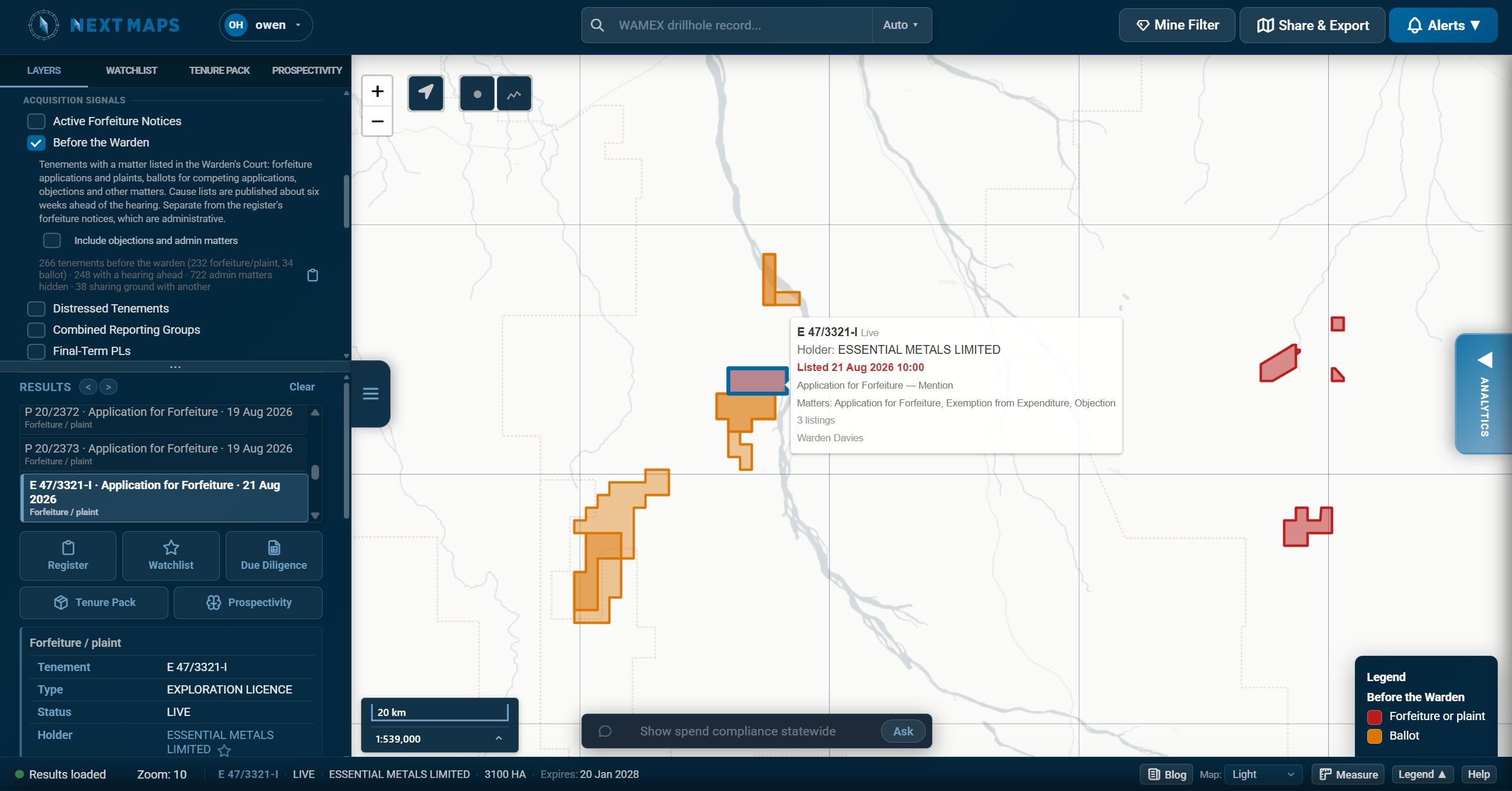
We have just added Before the Warden to the Tenement Intelligence layers: tenements with a matter listed in the Warden's Court, plotted on the ground the matter concerns.
Clean on this year's numbers, short on the record
Here is what surprised us when we first plotted it. Of the 230 live tenements facing a forfeiture application in the court, 220 are paid up on rent, and on the latest completed expenditure year they sit above the median for live tenure across the state, at around 1.5 times their minimum. On the numbers a distress screen actually reads, they look fine.
Look at the whole term instead and it changes. Of the exploration licences before the court, 73% have met their term commitment, against 95% of every other exploration licence in WA. The shortfall is in the record rather than in this year, which is exactly why a current-year screen walks past it.
A forfeiture application or a plaint in the Warden's Court is usually a third party moving on someone else's ground. The department's own forfeiture notices, the ones driven by unpaid rent or short expenditure, are a different process entirely, and the two populations largely differ: around two in three of the tenements facing a court forfeiture carry no forfeiture notice on the register at all. So a tenement can be in a fight for its life and barely register on the compliance metrics we compute. The evidence is in the register. It is just not in the number most screens read.
What the layer shows
Cause lists are published well ahead of the hearing, about six weeks in practice, so this is forward-looking by nature. Matters are coloured by what is at stake:
- Forfeiture applications and plaints: the tenement itself is at stake
- Ballots: competing applications over the same ground, decided by draw
- Objections and administrative matters: extensions of time, exemptions, restorations, available as an optional overlay
That last group is off by default. It is the bulk of the cause list by volume, mostly large administrative mentions covering dozens of tenements at once, and left on it buries the matters that actually change who holds ground.
Click any polygon and you get the hearing date and time, the type of matter, the list type, the warden, and the holder. The clipboard button next to the layer sends everything on screen to the results panel, ordered by what is coming up soonest, so you can work down the list rather than hunt across the map for the next hearing.
The ballot problem, and what we did about it
A ballot is the purest contest in WA tenure. Two or more parties apply for the same ground, often on the same day, and the winner is drawn rather than reasoned. If you hold or want ground nearby, knowing a ballot is on is worth a great deal.
There is a catch. The cause list frequently names only one of the applicants. Plot it faithfully and you get a single polygon, one company, and no hint that the ground is contested at all.
So we stopped relying on the court record for that answer. NextMaps holds its own nightly copy of WA tenure geometry, and competing applications for the same ground have, by definition, the same footprint. When a matter is listed against one tenement, we look up every other tenement standing on exactly that footprint and name it, with its status and its holder, whether or not the court record mentions it.
One ballot in the Pilbara lists a single exploration licence. Underneath it sits a second licence: identical boundary, lodged the same day, different applicant. The cause list names one. The map now shows you both.

The same lookup handles the general case of stacked tenure. Where two applications sit on identical ground, the map draws that ground once rather than piling translucent polygons on top of each other, and the popup names everything standing on it. Where they only partly overlap, both are drawn and each names the other.
You do not have to remember to look
A layer only helps the day you switch it on. Cause lists do not wait for that.
So the alerts you already have can carry this too. Open any alert, whether it watches an area you have drawn, a company you follow, or a list of specific tenements, and tick Warden's Court matters. When something is listed against that ground we email you within about fifteen minutes of the cause list being published, which given the six-week lead time means you hear about it a long while before the hearing.

Only the matters where the tenement itself is at stake will email you: forfeiture applications, plaints and ballots. Objections and administrative mentions run at dozens a week and would turn a useful alert into something you filter into a folder, taking the forfeiture notice with it.
What it does not do
Worth being straight about the limits, because they matter for how you use it.
Cause lists publish hearings, not outcomes. The court tells the world that a matter is listed for a given morning. It does not publish what the warden decided. So this layer tells you what is on foot and when, and it will not tell you who won.
Our collection also began in May 2026. The feed carries upcoming hearings only, so matters heard before we started are not recoverable, and the layer cannot tell you that a tenement has never been before the warden. Only that nothing has been listed against it since we started watching.
And it is not a pegging feed. A ballot is ground already applied for, an objection is an application being contested, and a forfeiture plaint is a fight over a live tenement with a plaintiff already in the queue. None of it is ground you can walk onto tomorrow. For that, surrenders, expiries and the compulsory release pool are still the sharp end, and they are all still where they were.
Where to find it
Open the map, expand Tenement Intelligence, and tick Before the Warden under Acquisition Signals. The alert option sits on any alert you create, under the tracking choices. Both are available on Premium and Pro.
If you are watching a district where ground changes hands through the court rather than through the register, this is the layer that was missing. Take it for a run and tell us what you would want next.
Track WA tenements and find ground to peg, sell or buy
NextMaps gives exploration companies and investors instant visibility over the full WA tenement landscape.
Get started →